 ES
ES



Results 14
Used Okuma Machines






About Okuma
Okuma was founded in 1898 in Nagoya, Japan, making it one of the oldest and most established machine tool builders in the world. The company originally began producing noodle-making machines and later transitioned into machine tool manufacturing in the early 20th century.
Over the following decades, Okuma became known for producing highly reliable machine tools and was one of the early pioneers in the development of numerical control machining technology.
One of the defining characteristics of Okuma machines is that the company manufactures both its machine tools and its CNC controls in-house. While many machine tool builders rely on third-party controls such as Fanuc or Siemens, Okuma machines use the company’s proprietary OSP (Okuma Sampling Path) control system.
This integrated approach allows Okuma to tightly coordinate machine hardware and software, resulting in high levels of accuracy, thermal stability, and reliability.
Because of this engineering philosophy, Okuma machines are widely used in industries that require tight tolerances and consistent machining performance, including aerospace, automotive manufacturing, energy production, and precision component manufacturing.
Okuma Vertical Machining Centers
Okuma vertical machining centers are widely used for milling operations involving aluminum, steel, stainless steel, and other materials.
One of the most widely recognized machine families is the MB Series, which has been produced since the early 2000s.
Common machines include:
- MB-4000H (early 2000s – 2010s)
- MB-5000H (2000s – 2010s)
These machines are known for their rigid construction and reliable performance in production machining environments.
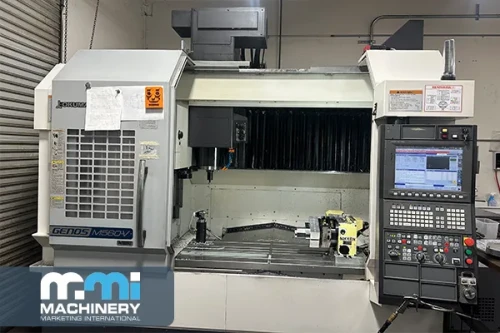
More recent vertical machining center platforms include the GENOS M Series, which was introduced during the 2010s as a compact, high-performance vertical machining center designed for job shops and production machining.
Common models include:
- GENOS M560-V (2010s – present)
- GENOS M460-V (2010s – present)
In the Okuma naming convention, the model number often reflects the machine’s table size or machining envelope.
Okuma Horizontal Machining Centers
Horizontal machining centers are commonly used for production machining where pallet changers allow shops to machine multiple parts without stopping the spindle.
Okuma horizontal machining centers are well known through the MA Series and MB-H Series.
Popular machines include:
- MA-400HA (1990s – early 2000s)
- MA-600HB (2000s)
- MB-4000H (2000s – 2010s)
These machines are commonly used in industries such as automotive manufacturing, heavy equipment production, and aerospace machining.
The model number typically corresponds to the pallet size or machining capacity, helping buyers quickly determine the appropriate machine for their production requirements.
Okuma CNC Lathes
Okuma CNC lathes are widely used for high-precision turning operations. These machines are commonly used to produce shafts, housings, and cylindrical components used in industrial equipment and mechanical assemblies.
One of the most widely known Okuma turning center families is the LB Series.
Popular machines include:
- LB3000 EX (2000s – present)
- LB4000 EX (2000s – present)
In the LB naming structure, the number typically refers to the machine size and turning capacity.
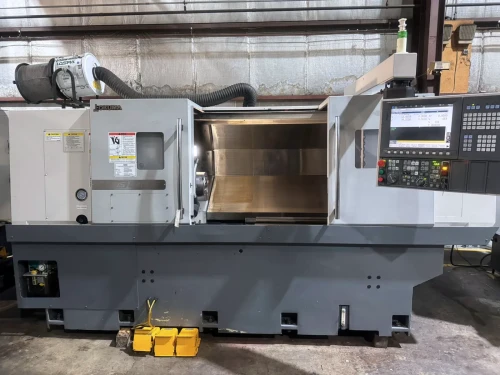
Another widely used lathe platform is the GENOS L Series, which provides compact turning centers designed for efficient production machining.
Common models include:
- GENOS L3000 (2010s – present)
These machines are often equipped with live tooling and Y-axis capabilities, allowing milling operations to be performed directly on the lathe.
Okuma B-Axis CNC Lathes
Okuma B-axis CNC lathes allow milling and turning operations to be performed within the same machine platform.
These machines are typically part of Okuma’s MULTUS Series, which combines multi-axis milling and turning capabilities.
Common machines include:
- MULTUS B200 (2000s – present)
- MULTUS B300 (2010s – present)
In the MULTUS naming convention, the “B” indicates the presence of a B-axis milling spindle, allowing the machine to approach the part from multiple angles.
These machines are widely used in aerospace and medical manufacturing where complex geometries must be produced with high precision.
Okuma Multi-Spindle CNC Lathes
Multi-spindle CNC lathes are designed for high-volume production environments where multiple parts can be machined simultaneously.
Okuma has developed several multi-spindle turning platforms designed to increase productivity in industries such as automotive manufacturing and precision component production.
These machines allow manufacturers to significantly reduce cycle times when producing large quantities of parts.
Okuma Vertical Turret Lathes
Vertical turret lathes (VTLs) are used to machine large, heavy components such as gears, bearings, and industrial housings.
Okuma produces vertical turning centers such as those in the VTM Series, which combine vertical turning with milling capability.
Common machines include:
- VTM-1200 (2000s – present)
- VTM-2000 (2010s – present)
These machines are frequently used in industries such as energy production, heavy equipment manufacturing, and aerospace machining.
Okuma Mill-Turn Machines
Mill-turn machines combine turning and milling operations within a single machine platform.
Okuma’s most well-known mill-turn machines are part of the MULTUS Series, which allows manufacturers to perform complex multi-axis machining operations in a single setup.
Machines such as the MULTUS U3000 and MULTUS U4000 are widely used in industries requiring high-precision complex components.
These machines are commonly used in aerospace, medical manufacturing, and high-precision mechanical component production.
Okuma Grinding Machines
In addition to machining centers and turning centers, Okuma also manufactures precision grinding machines used in finishing operations.
Cylindrical Grinders
Cylindrical grinding machines are used to grind external diameters of cylindrical parts with extremely tight tolerances.
Okuma cylindrical grinders are commonly used in industries requiring high-precision shafts and rotating components.
ID Grinders
Internal diameter (ID) grinders are used to grind the internal surfaces of components such as bearing races and precision mechanical housings.
These machines allow manufacturers to achieve extremely tight tolerances on internal features.
OD Grinders
Outside diameter (OD) grinders are used for finishing external surfaces of precision components. These machines are frequently used in industries such as aerospace, automotive manufacturing, and toolmaking.
Why Buyers Look for Used Okuma Machines
Buyers searching for used Okuma machines are often looking for equipment that offers:
- strong machine construction and durability
- highly accurate machining performance
- proprietary Okuma OSP CNC controls
- advanced multi-axis machining capability
- strong reputation for reliability in production environments
Another reason Okuma machines perform well in search traffic is that buyers frequently search by specific model families, such as LB3000 EX lathes, MULTUS mill-turn machines, or GENOS machining centers.
Including these machine families helps buyers quickly determine whether a machine matches their production requirements.
Find Used Okuma CNC Machines
MMI helps manufacturers locate used Okuma CNC machines for sale from trusted sellers across the country. If you do not see the exact Okuma model you need, contact our team and we can help source additional machines through our network.
|
Okuma Vertical Machining Centers (MB, GENOS M, & Related Series) |
Models |
|
Okuma MB Series: Vertical Machining Centers for General Purpose Milling |
Okuma MB-4000H, Okuma MB-5000H, Okuma MB-56VA, Okuma MB-66VA |
|
Okuma GENOS M Series: Entry-Level Vertical Machining Centers with High Performance |
Okuma GENOS M460-V, Okuma GENOS M560-V |
|
Okuma MC-V Series: Legacy Vertical Machining Centers Widely Used in Job Shops |
Okuma MC-4VA, Okuma MC-5VA, Okuma MC-6VA |
|
Okuma Horizontal Machining Centers (MA, MB-H Series) |
Models |
|
Okuma MA Series: Horizontal Machining Centers for High Production Applications |
Okuma MA-400HA, Okuma MA-500HB, Okuma MA-600HB |
|
Okuma MB-H Series: Horizontal Machining Centers Designed for Productivity and Automation |
Okuma MB-4000H, Okuma MB-5000H |
|
Okuma 5 Axis Machining Centers (MU, MCR Series) |
Models |
|
Okuma MU Series: Universal 5 Axis Machining Centers for Complex Parts |
Okuma MU-400VA, Okuma MU-500VA, Okuma MU-6300V |
|
Okuma MCR Series: Double Column 5 Axis and Gantry Machining Centers for Large Workpieces |
Okuma MCR-A5C, Okuma MCR-B5C |
|
Okuma CNC Lathes (LB, GENOS L Series) |
Models |
|
Okuma LB Series: CNC Turning Centers for General Purpose and Production Turning |
Okuma LB2000, Okuma LB3000, Okuma LB4000 |
|
Okuma GENOS L Series: Modern CNC Lathes with Advanced Controls |
Okuma GENOS L2000, Okuma GENOS L3000 |
|
Okuma B-Axis CNC Lathes (MULTUS Series) |
Models |
|
Okuma MULTUS Series: Multi-Tasking CNC Lathes with B-Axis Milling Capability |
Okuma MULTUS B200, Okuma MULTUS B300, Okuma MULTUS B400 |
|
Okuma MULTUS U Series: Advanced Multi-Tasking Machines with Upper/Lower Turrets |
Okuma MULTUS U3000, Okuma MULTUS U4000 |
|
Okuma Multi Spindle CNC Lathes (LU Series) |
Models |
|
Okuma LU Series: Twin Spindle CNC Lathes for High Production Turning |
Okuma LU15, Okuma LU25, Okuma LU300 |
|
Okuma Vertical Turret Lathes (V-Series) |
Models |
|
Okuma V-Series: Vertical Turret Lathes for Large Diameter Turning Applications |
Okuma V40R, Okuma V60R |
|
Okuma Mill/Turn Machines (MULTUS Platform) |
Models |
|
Okuma MULTUS Multi-Tasking Series: Combined Milling and Turning Machines |
Okuma MULTUS B200, Okuma MULTUS B300, Okuma MULTUS U3000 |
|
Okuma Cylindrical Grinders (GP, GA Series) |
Models |
|
Okuma GP/GA Series: Cylindrical Grinding Machines for Precision Finishing |
Okuma GP-25, Okuma GP-36, Okuma GA-26T, Okuma GA-36T |
|
Okuma ID Grinders |
Models |
|
Okuma ID Grinding Machines: Internal Diameter Grinding Systems for Precision Bores |
Okuma GI-20N, Okuma GI-30N |
|
Okuma OD Grinders |
Models |
|
Okuma OD Grinding Machines: External Diameter Grinding Systems for Precision Shafts |
Okuma GP-25, Okuma GP-36 |